Français Request a demo

Tselora › Multi-company groups

Small groups, holdings and sister companies

Your companies in one tool. Invoices between them write themselves.

What large groups get from heavy ERP systems, within reach of a group of a few companies: each entity keeps its currency and its accounts, and the flows between them are invoiced, netted and settled without double entry.

  • One currency and chart of accounts per company
  • Automatic mirror invoice
  • You only pay the difference
  • Rights per user
Tselora overview for one company of the account: arrears, overdue supplier invoices, requests to approve, months to close and assets.

Screens shown in French. The interface is also available in English, user by user.

Sound familiar?

"Every sale between our companies is entered twice, and the accounts never agree."

The mirror invoice is created automaticallyWhen one company sells goods that belong to another, the internal invoice is born from the customer invoice. The buying company receives it already recorded.
"Our companies owe each other money in both directions."

Balances are nettedThe balance per counterparty shows what each company owes and is owed. Netting happens in the same action as payment of the difference.

"Shared costs and head-office services are recharged when someone remembers."

A monthly recharge, prepared for youRecurring services, costs paid on behalf and shared charges are prepared every month according to your agreements. You approve, the invoices go out.

What you see on screen

One view per company, the same account for all

You switch company from the top bar. Each has its own currency, chart of accounts, periods and pending tasks. Partners, products and users are shared.

  • A group company is created once, as both customer and supplier
  • Rights set per user, including access to cash figures
  • Monthly closing per company, periods opened and closed in order
  • Every action traced: who, when, on which document
Tselora overview with the company selector in the top bar and cards of what needs attention across all modules.

Several currencies, with no manual calculation

Every document keeps its amount in the transaction currency and its value in the company currency. Rates come from a daily file, or are set by you.

  • Currency carried by the customer or supplier
  • Market rate or fixed rate
  • Month-end revaluation, exchange difference posted
  • Adjustable intercompany markup on the internal invoice
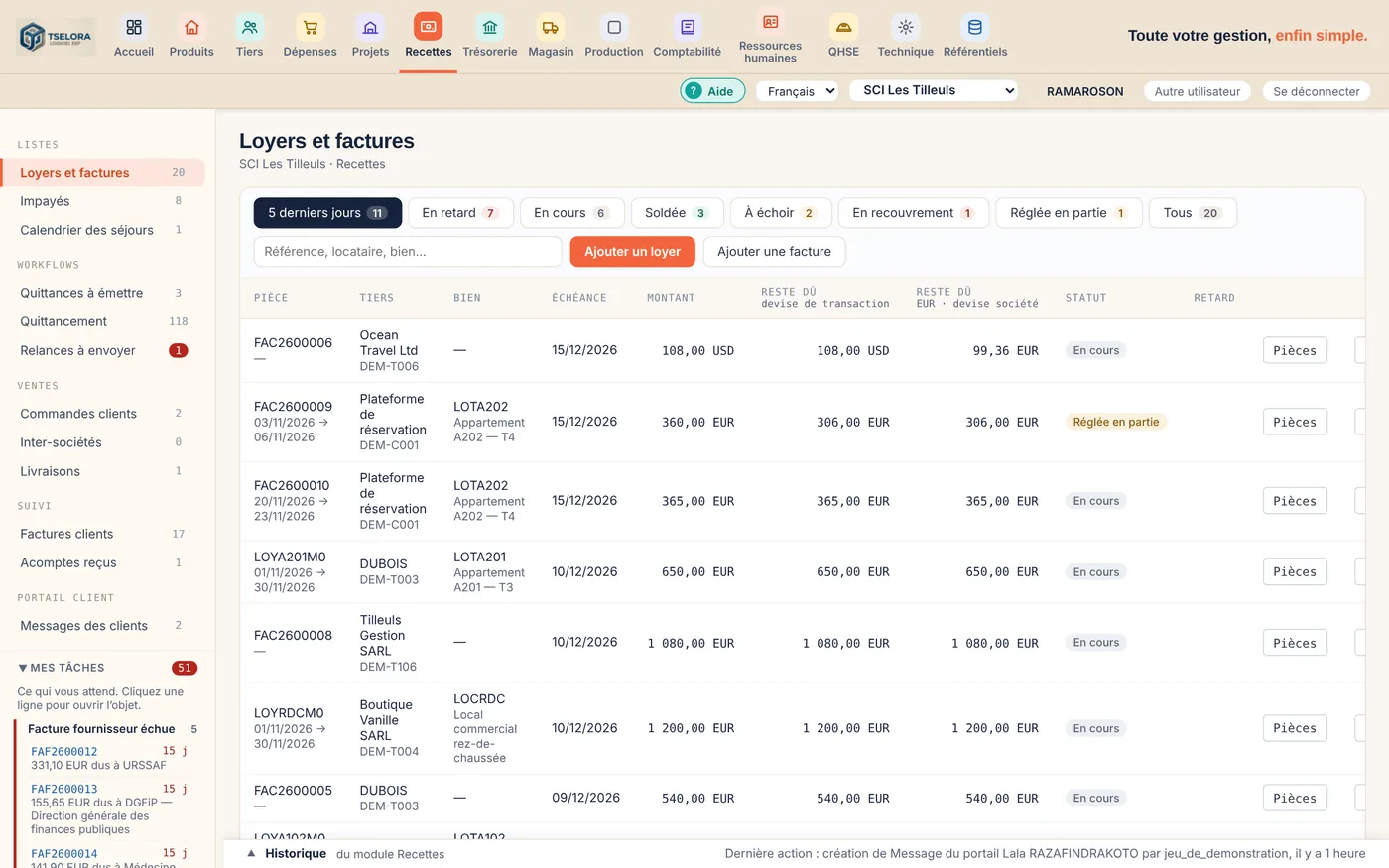
Tselora invoice list with two balance-due columns: in the transaction currency, here an invoice in US dollars, and in the company currency, in euros.

In the same tool

You only open the modules you need. The others are waiting on the same account, with no new tool and no data migration.

  • Several companies
  • Several currencies
  • Intercompany sales
  • Monthly intercompany services
  • Balance netting
  • Chart of accounts per company
  • Cost and profit centres
  • Monthly closing
  • Cash and bank reconciliation
  • Audit trail
  • Rights and approvals
  • All other modules
Questions

Your questions

Does Tselora produce consolidated accounts?

No. Tselora keeps the accounts of each company and keeps intercompany flows in agreement on both sides, which prepares consolidation. Consolidation itself stays with your accountant or your dedicated tool.

How many companies can be managed?

As many as needed on the same account. The subscription depends on the number of users, not on the number of companies.

Our companies are in different countries. Is that a problem?

No. Each company carries its currency, chart of accounts and VAT regime, and VAT on internal flows is set on the company record. Country-specific returns are defined with you during set-up.

Bring a real case. We will enter it together.

A demonstration takes one hour, remotely, on Microsoft Teams, in English or French. Tell us about your business first so that it starts from your own figures.